
Laboratory confirmation of malaria infection is an essential component of fever case management, and should be provided at all levels of healthcare to ensure correct patient management, and minimise the use and cost of anti-malarial treatment drugs. The Global Technical Strategy for Malaria 2016–2030 was adopted by the World Health Assembly in May 2015 with the aim of achieving a malaria-free world by 2030. To achieve these goals countries must adopt policies and practices that improve the quality of malaria diagnosis. Improved quality of laboratory-confirmed diagnosis of malaria will retain the confidence of clinicians in laboratory results, leading to improved case management and appropriate use of antimalarial drugs.
It is recommended that participants planning to take the WHO AFRO/Amref Health Africa External Competency Assessment of Malaria Microscopists (ECAMM) course first take the Refresher Training Course in Laboratory Diagnosis of Malaria to be adequately prepared for the ECAMM course.
By the end of this course, you should be able to:
- Improve the quality of malaria microscopy and essential malaria diagnostic procedures, including use of malaria rapid diagnostic tests (RDT)
- Ensure malaria diagnostic services are manned by competent and motivated staff.
Participants planning to take the WHO AFRO/Amref Health Africa External Competence Assessment of Malaria Microscopists (ECAMM) course are encouraged to first take the Malaria Diagnostic Refresher Training (MDRT) Course to be adequately prepared for the ECAMM course.
This course is conducted by Amref Health Africa’s Regional Laboratory Programme and is held at Amref’s Central Laboratory, Nairobi, Kenya. Alternative locations are considered on request.
The course will be conducted in Nairobi, Kenya, on the following dates:
- 11 – 15 May 2026
- 14 – 18 September 2026
Other trainings may be conducted on request at suitable locations, subject to availability of appropriate facilities.
Participants should be laboratory technologists, laboratory technicians or pathologists working mainly in the malaria or parasitology sections of medical diagnostic laboratories. A maximum of 15 participants are accepted per course due to its practical nature and need for personal instruction.
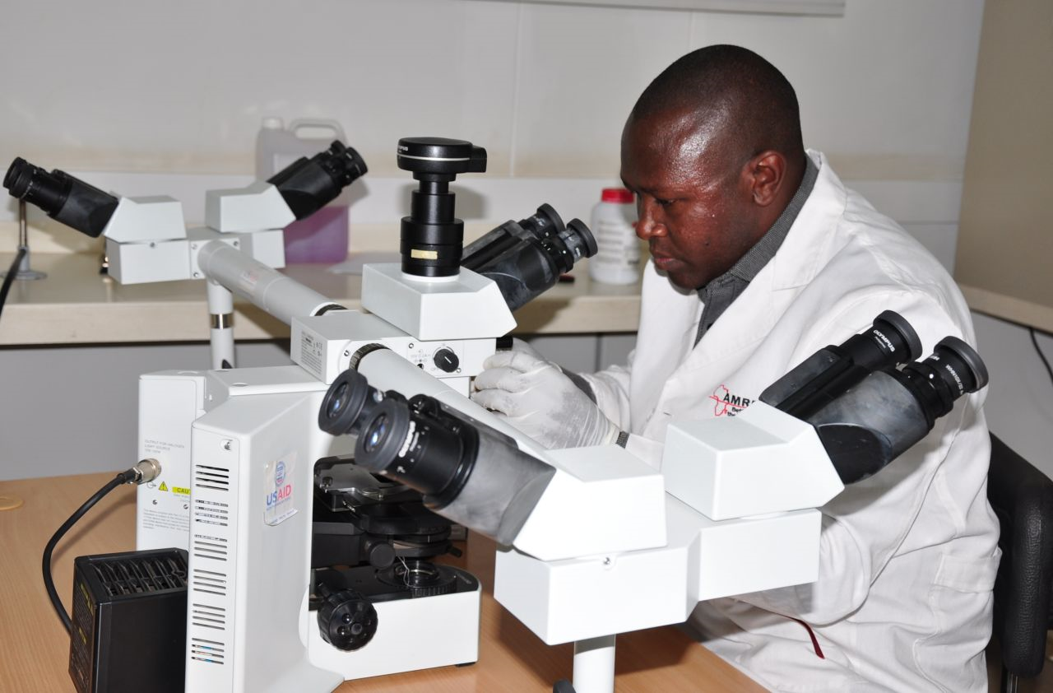
This one week intensive course is approved by the KMLTTB for award of 50 CPD points. It includes a minimum of 35 structured tutor contact hours. Training comprises lectures, discussions, laboratory practice, slide review, and demonstrations, with daily sessions of 2.5 hours theory and 4.5 hours practical, covering blood film preparation and staining, microscopy of well-characterised slides, and appropriate use of malaria RDT.
At the end of this training course, the participants will be expected to:
- Demonstrate an understanding of the epidemiology of malaria.
- Describe the biology of the malaria vector and parasite.
- Prepare thick and thin blood films and stain the films to a high standard.
- Identify all human malaria species (P.f, P. v., P.o., P.m) microscopically.
- Identify all malaria parasite stages microscopically.
- Differentiate pseudo-parasites and artifacts from true malaria parasites.
- Quantify malaria parasites accurately.
- Carry out malaria Rapid Diagnostic Tests (RDTs) correctly.
- Identify sources of errors in malaria diagnosis and discuss their remedies.
- Maintain and store microscopes properly.
- Participate in development of national and facility-based plans for QA/QC in malaria diagnosis.
- Monitor the performance of malaria Rapid Diagnostic Tests (RDTs).
- Develop and maintain Standard Operating Procedures (SOPs).
- Perform technical work according to standards of good laboratory practice (GLP).
Participants should be prepared to provide information of malaria laboratory diagnostic activities in their countries, and to prepare and present draft workplans for improving malaria diagnostic services in their places of work.
Throughout the course, participants will be examined to determine the acquisition of knowledge, skills and competence. Participants will be assessed at the beginning and end of the course to measure improved performance and will receive a Certificate of Attendance at the close of the course.
USD 1500 per person covering the following:
- USD 760 for tuition fees which includes: provision and maintenance of slides from the slide bank, training materials, facilitation and coordination, laboratory supplies, and use of equipment and training facilities
- USD 90 for lunch, tea and snacks – this cost is added to the tuition fees for Nairobi-based courses
- USD 650 for accommodation, dinner, local transport and incidental costs for Nairobi-based residential participants.
The course is approved by the KMLTTB for the award of 50 CPD points
For further information about the course, kindly contact:
The Laboratory Training Coordinator
Amref Health Africa Headquarters – Laboratory Training Programme
P O Box 327691 – 00506, Nairobi, Kenya
Email: [email protected] or [email protected]
For more information, click here for the course information worksheet.
Want to know more about this course? Reach out here