From Crisis to Care: Strengthening Africa’s Health Workforce to Combat Cardiometabolic Diseases

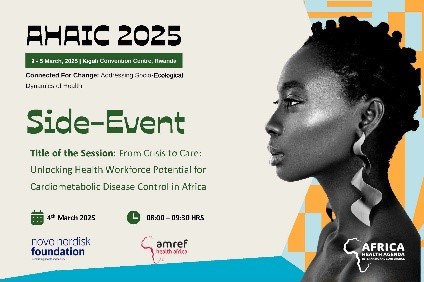
Kigali, Rwanda, brought together key stakeholders under the theme ‘Connected for Change: Addressing Socio-Ecological Dynamics of Health’ to tackle the continent’s most pressing health challenges. One of the pivotal sessions, hosted by Amref Health Africa in collaboration with the Novo Nordisk Foundation, focused on health workforce, highlighting the urgent need for equipping them to be better prepared for the emerging burden of cardiometabolic diseases (CMDs).
The session convened a panel of experts from Amref Health Africa, Novo Nordisk Foundation, Siemens Healthineers, Africa CDC, and PATH Rwanda to discuss strategies for strengthening the health workforce in response to the rising burden of CMDs. Additionally, the session featured a powerful testimony from Ellie Bizumuremyi, a University of Rwanda student with lived experience of CMD, highlighting the real-world impact of these diseases.

CMDs are on the rise across Africa, posing a significant public health and economic challenge. These diseases, including cardiovascular conditions, hypertension, diabetes, obesity, dyslipidemia and metabolic disorders, are increasingly straining healthcare systems, which are already under pressure from infectious diseases and resource constraints. Without urgent intervention, CMDs threaten to overwhelm fragile health systems and deepen socio-economic inequalities.
The Growing Burden of Cardiometabolic Diseases
CMDs are rapidly emerging as a major public health crisis, becoming a leading cause of morbidity and mortality globally, with cardiovascular diseases alone responsible for an estimated 17.9 million deaths each year (World Health Organization, n.d). In Africa, non-communicable diseases (NCDs) accounted for 37% of all deaths in 2019 (World Health Organization, 2023). This burden is exacerbated by shifting dietary habits, increasing obesity rates, urbanization, and limited access to healthcare. The prevalence of obesity is surging, with projections indicating that 45% of African women and 26% of men will be obese or overweight by 2030 (World Obesity Federation, 2023). Similarly, diabetes is on the rise, with an estimated 24 million people living with diabetes in Africa in 2021 (World Health Organization, 2023). Beyond the health implications, CMDs pose a significant socio-economic challenge that threatens to destabilize entire health systems. African countries, already grappling with limited resources and underdeveloped health infrastructures, face compounded challenges as they confront both infectious diseases and a rising tide of NCDs, with CMDs among the most pressing. As a major driver of NCD-related deaths, CMDs place immense pressure on healthcare systems, contributing to escalating costs from hospitalizations, loss of productivity, and long-term treatment, deepening health inequalities and leading to significant economic strain.
Health Workforce Challenges: Gaps and Opportunities

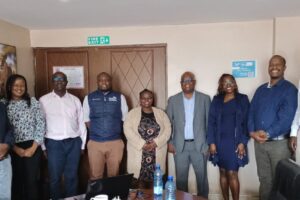
CMD panel during AHAIC 2025 L-R Dr. Mohammed AbdulAziz (Africa CDC), Dr Catherne Kanari (Amref Health Africa), Dr Tiruneh Baye (Africa CDC), Dr Florence Sibomana (PATH Rwanda), Dr Zoya Iqbal (Siemmens Healthineers) and Mette Davidsen (Novo Nordisk Foundation)
Source – Amref Health Africa
Despite the growing CMD crisis, Africa’s health workforce remains critically under-resourced. Nurses, clinical officers, and community health workers are often the first line of defense against these diseases, yet they lack specialized training in CMD management. Additionally, the migration of health workers to higher-income countries has further depleted Africa’s healthcare workforce.
Dr. Tiruneh Baye, Technical Officer for Health Workforce Development at Africa CDC, highlighted the scale of the crisis:
“One of the biggest challenges is the quantity of healthcare workers. We don’t have an adequate workforce across the continent, and the current stock is not even half of what is required.”
The session identified key barriers to effective cardiometabolic disease (CMD) workforce development in Africa. A major challenge is limited specialized training, as many medical and nursing curricula lack a strong focus on CMDs and their local health context. Workforce migration further strains the system, with thousands of healthcare professionals leaving for better opportunities abroad, exacerbating existing shortages. Additionally, fragmented health services hinder coordinated care, while underfunded health systems limit the expansion of CMD-focused training and services.
To address these gaps, experts emphasized the need for structured and continuous education to shift from reactive to proactive care. Key strategies include integrating CMD-specific education into medical curricula, leveraging digital learning platforms for greater accessibility, fostering multidisciplinary collaboration among healthcare professionals, and strengthening the role of community health workers in early detection and follow-up care, particularly in rural areas.
Investing in the Workforce: Beyond Numbers
A key takeaway from the discussion was the need to train and support healthcare workers equipping them with specialized skills to tackle CMDs. Mette Davidsen, Director of Global Health Programmes, Social and Humanitarian- Novo Nordisk Foundation emphasized,
“We must move beyond just treating symptoms—health professionals need to be equipped to diagnose and prevent NCDs early.”
Dr. Mohammed Abdulaziz Head, Division of Disease Control and Prevention echoed this by stressing the shift from external dependency to local empowerment:
“We must move from dependency to self-sufficiency in healthcare innovation—Africa has the expertise, but we need the right investments to scale solutions.”
By equipping healthcare workers with the necessary skills, Africa can build a workforce that is not only growing in numbers but also in expertise. A well-trained workforce will be better prepared for the evolving health landscape and the increasing burden of CMDs, ensuring that the fight against these diseases is sustainable and effective.
Financing the Future: Where Will the Money Come From?
Financing remains one of the most critical barriers to effective CMD prevention and care, with African countries allocating an average of 7.4% of their GDP to health—far below the 15% commitment set in the Abuja Declaration (Human Rights Watch, 2024). Dr. Baye emphasized the need for sustainable funding models:
“We must rethink how we approach healthcare financing because sustainable health outcomes depend on sustainable funding models.”
Beyond traditional funding sources, there is an urgent need for public-private partnerships, innovative financing mechanisms, and stronger government commitments to ensuring long-term investment in CMDs. Without this, other interventions risk being unsustainable.
Moving from Crisis to Care
The session reinforced that Africa’s health workforce must be at the center of the fight against CMDs. Dr. Githinji Gitahi, Group Chief Executive Officer of Amref Health Africa, summarized:
“The best advocates for health policy change are health workers themselves. We must equip them to push for better regulation of sugar, trans fats, and lifestyle changes.”
Prof. Flemming Konradsen, Senior Vice President, Social and Humanitarian, Novo Nordisk Foundation, reinforced this point, stating,
“We cannot just treat our way out of obesity, diabetes, and kidney failure. Prevention has to be a very strong focus.”
The future of Africa’s health workforce isn’t just about numbers—it’s about ensuring they are well-equipped to lead the fight against CMDs. The Partnership for Education of Health Professionals (PEP), a collaborative initiative between The Ministry of Health in Kenya, six Kenyan partners including Amref Health Africa and the Novo Nordisk Foundation (NNF), is already making significant strides in strengthening the health workforce to combat CMDs. By strengthening the middle level institutions that educate future health professionals to deliver better CMD training, across Kenya and East Africa, PEP ensures that health professionals are equipped not just to treat but to prevent CMDs at the primary health care level.
Through digital learning, curriculum enhancement, and partnership, the programme is bridging critical capacity gaps by training professionals in prevention, early diagnosis, and long-term management strategies. This initiative represents a concrete step toward shifting from crisis response to proactive prevention, demonstrating that investing in capacity-building in the workforce is a crucial pillar in strengthening health systems and tackling CMDs effectively.
A Call to Action

| Dr Githinji Gitahi, Amref Health Africa GCEO giving an opening address during the parallel breakfast panel discussions on CMDs during the AHAIC 2025 Source – Amref Health Africa – AHAIC 2025 |
The growing burden of CMDs in Africa demands urgent action. The challenge ahead is clear: health systems must integrate preventive strategies, strengthen training programs, and foster innovation. With the right training, technology, financial investments, and multi-sectoral collaboration, Africa can shift from crisis response to proactive prevention building a stronger, more resilient health system. Dr. Githinji Gitahi echoed this urgency, stating,
“We know exactly what we need to do. The question is, why are we not doing it? If we don’t take action now, the impending collapse of African health systems is not far away.”
As policymakers, healthcare leaders, and stakeholders reflect on these discussions, decisive next steps will be crucial in empowering Africa’s health workforce and improving patient outcomes. Without immediate action, the rising burden of CMDs could reverse hard-won health gains across the continent.
Now the real question is: Are we ready to make the necessary investments before it’s too late?